I'm not sure whether or not you all know this, but I am not a big fan of horror movies. I watched a bunch of scary movies as a younger child with my father and I couldn't sleep for some reason. Every time I would close my eyes, I would see the movie, wake up sweaty, fall back asleep, and wake up again and again in my own sweat. The ordeal would be over when the morning sun finally rose.
For the sake of this project, I am going to talk about 2 of my most memorable experiences with films in the horror family. This is going to sound weird, but both of these movies are referenced within the Clover reading that we were assigned. The two movies that I will be discussing are "Alien" and "Psycho".
I will begin with "Psycho" because it is a very classic movie and I remember the circumstances behind me watching it much better than "Alien". First of all, when I watched this movie, I was about 8 or 9. My father said that we should watch the movie, and my brother and I agreed because it sounded like a good idea. We watched the movie in the evening in my father's basement apartment in Ronkonkoma. My brother and I were both in our pajamas and we were laying on the fold-out couch in the living room. My father was sitting in his armchair (like always), and he began the movie.
For those of you who have not seen "Psycho", the movie basically begins with a distressed employee stealing money and fleeing town. She drives a while, spends a night in the car, draws attention from a police officer, and decides eventually to stay at the Bates Motel. While there, everything is fine, and the girl (Marion), decides to take a shower. While in the shower, a female figure, presumed to be Mrs. Bates, the mother of the hotel clerk, comes into the shower and stabs Marion to death. Norman, the hotel clerk, later comes in and is horrified when he finds the bloody mess. He then dumps her body in her car and dumps the car into a nearby lake.
After more filling details and another killing, two other characters decide to investigate and stay in the motel. While there, they find evidence of Marion and the male (Sam) decides to confront Norman alone. When confronting him, Norman knocks him out with a golf club. In the meantime, Lila (the other character) decides to sneak into the house while Norman is distracted. She hides in the cellar and discovers, completely by accident, the mummified body of Norman's mother. At this point, Norman rushes in dressed like his mother and is suppressed by Sam, who was no longer unconscious.
At the end of the film, the viewer realizes that it was Norman who was both himself and his mother. He had a dual personality which included both himself and his mother and he was permitting her to live even though she was dead.
Now, I reacted to one part of this film in particular. The part that really scared the crap out of me was when Lila turned around the armchair with the mummified body and saw the dead mother. I don't know why, but this part absolutely shocked me at the same time as scaring me. That night, when I went to sleep, all I could picture was that dead face and that mummified body just staring at me from the armchair. The fact that there was stabbing and killing didn't bother me in the slightest. It was the fact that there was the mummified mother that really bothered me. This is the part that I can't explain, but this movie really left an imprint in my brain and after that, I didn't watch any horror movies for a LONG time!
As far as Psycho goes, I would say that I agree with the Clover piece. Psycho really did set the stage for slasher films of the future. The fact that Norman used a knife to murder Marion in the shower, and the fact that there was a lot of blood in the movie really changed the way that those types of movies were made. Also, Clover's arguments that the killer usually has sexual issues would prove true because the killer (Norman) was both a man and a woman. He didn't have a sexual identity and whenever he did develop feelings for a woman, as he did with Marion, his other personality (his mother) ordered him to kill her. In essence, he was incapable of having sexual relations with women because of his alter-ego.
The aspects of the Clover piece describing the "Final Girl" don't necessarily apply, unless you count the part of the movie where Lila is about to be stabbed by Norman in the end. However, I don't think that this concept applies because of the fact that she is saved by Sam. While the "Final Girl" might not necessarily apply, the idea of a terrible place is definitely present. Whether it be the dirty motel bathroom where Marion is murdered, or the creepy basement where the mummified mother is discovered, this movie is full of places that would make your skin crawl.
The second movie that I would like to discuss is the movie "Alien". I don't really remember much about this movie, but I do remember several ways in which I reacted to it. I am not going to go into the plot, but I will make some references.
Watching this movie was, again, my father's idea, and my brother and I watched it in the same place that we watched Psycho. This movie was quite different than movies I had watched before. It was much more gory than other movies and had a lot of death. In fact, every single character died except Ripley.
I reacted to this movie quite negatively I'm afraid. First of all, the thought of an alien attacking me wasn't very pleasant and my dreams didn't seem to think so either. Secondly, I was afraid that if I sat down at my table and ate, I would have an alien burst out of my stomach. I was deathly afraid of this and the night I watched "Alien" I couldn't even eat my steak because it reminded me of the alien. I look back on these moments now and laugh, but back then my fears were legit.
This film, unlike Psycho, applies the "Final Girl" principle of the Clover piece. Ripley, one of the only females in the movie, is the last to survive, and as the Clover reading suggests, she is a very masculine character. She is not a true female and she fits the description of the "final girl" described in the reading. She also has a great struggle with the alien before she finally is able to eject him from the ship using a forklift.
The other part of this movie that applies to the Clover reading was the way in which the characters of the film were killed. As suggested in the reading, each of the male characters were killed quite quickly and in most of the camera shots, the creature was not even showed, but instead a muffled scream was heard. However, Ripley's ending battle with the creature was very intense and it was really the focus of the movie. The ejection of the alien of the end was a victory for the "final girl".
Monday, November 23, 2009

Tuesday, November 10, 2009
Quick Apology
On Wednesdays I have class in the morning until 12:30...I didn't trust myself to publish all of these posts and fix all of the pictures and stuff so I posted a few hours early. Sorry again, but I don't think it should be that much of a problem. I just don't want to miss the deadline!
Thanks and enjoy the blog!!!
-Jake Lutz
Thanks and enjoy the blog!!!
-Jake Lutz
Blog Post 6 (Mid Term)
For my sixth and final post, I would like to examine many of the aspects of the media themselves. In this post, I plan to focus on the video gaming medium, while making references to all types of media in general.
My idea for this last post came to me earlier today while I was watching my roommate play the new Call of Duty game. My roommate, Mike, is a junior, and he is also in the army reserves. In the game, you play as a soldier deployed in Afghanistan and you start out walking around in a military base. As Mike walked around the virtual world, he stopped to comment on what life was like for soldier in Afghanistan and kept commenting on how real the situations were and how the brilliant graphics only enhanced the experience.
"These graphics are so f***** real, I can't even take it. They get better and better."
-Mike Maltese
All of a sudden I had this burst of inspiration and I had to write a specialized post as an ode to the evolution of graphics in video gaming. As with the evolution of media, video games started out very unrealistic and are slowly becoming more and more realistic, both in terms of the situations and graphics. In fact, I think I'll begin by comparing video games to early film. In the beginning of film, there were only short, black and white images with no sound. However, slowly, film evolved and became more and more like reality. The process began with the addition of sound to the films, and years later came the addition of real color to film. With each evolution, the medium came closer and closer to reflecting reality.
The exact same situation is occurring in video gaming. In fact, let me get some visual representation so that you can see the change for yourselves!
The following is gameplay footage taken from the "Goldeneye" game for the Nintendo 64:
(Keep in mind that this game was released only 12 years ago in 1997)
The following is gameplay footage taken from the newly released Call of Duty: Modern Warfare 2 game:
Now, if you watched both videos or even part of them you should notice an immediate difference. The second video is much more realistic looking than the first. If this doesn't demonstrate the evolution of graphics in the video game world, then I don't know what to say.
At any rate, my point in all of this, is that media has and always will strive to be more and more like reality. It does this to appeal to the users of that particular type of media. Radio is evolving to sound crystal clear so it almost seems like the DJ is next to you when he/she talks. Television has evolved so much that you can actually see each individual blade of grass on the football field, as if you were actually standing on the sidelines next to the coach! Film is following suit of TV, but the evolution is slower because going to the movies has a particular standard, and although movies are becoming more realistic, their growth is limited because of the fact that people expect the movie to be played on a screen and not necessarily on a gigantic television.
Each of these different mediums are evolving, some faster than others, but each keeps creeping closer and closer to reality. What is next on the horizon for different mediums? Virtual reality?
We'll just have to wait and find out...

I'm on my PC and Mike's Playing Call of Duty
Tuesday, November 10, 2009
My idea for this last post came to me earlier today while I was watching my roommate play the new Call of Duty game. My roommate, Mike, is a junior, and he is also in the army reserves. In the game, you play as a soldier deployed in Afghanistan and you start out walking around in a military base. As Mike walked around the virtual world, he stopped to comment on what life was like for soldier in Afghanistan and kept commenting on how real the situations were and how the brilliant graphics only enhanced the experience.
"These graphics are so f***** real, I can't even take it. They get better and better."
-Mike Maltese
All of a sudden I had this burst of inspiration and I had to write a specialized post as an ode to the evolution of graphics in video gaming. As with the evolution of media, video games started out very unrealistic and are slowly becoming more and more realistic, both in terms of the situations and graphics. In fact, I think I'll begin by comparing video games to early film. In the beginning of film, there were only short, black and white images with no sound. However, slowly, film evolved and became more and more like reality. The process began with the addition of sound to the films, and years later came the addition of real color to film. With each evolution, the medium came closer and closer to reflecting reality.
The exact same situation is occurring in video gaming. In fact, let me get some visual representation so that you can see the change for yourselves!
The following is gameplay footage taken from the "Goldeneye" game for the Nintendo 64:
(Keep in mind that this game was released only 12 years ago in 1997)
The following is gameplay footage taken from the newly released Call of Duty: Modern Warfare 2 game:
Now, if you watched both videos or even part of them you should notice an immediate difference. The second video is much more realistic looking than the first. If this doesn't demonstrate the evolution of graphics in the video game world, then I don't know what to say.
At any rate, my point in all of this, is that media has and always will strive to be more and more like reality. It does this to appeal to the users of that particular type of media. Radio is evolving to sound crystal clear so it almost seems like the DJ is next to you when he/she talks. Television has evolved so much that you can actually see each individual blade of grass on the football field, as if you were actually standing on the sidelines next to the coach! Film is following suit of TV, but the evolution is slower because going to the movies has a particular standard, and although movies are becoming more realistic, their growth is limited because of the fact that people expect the movie to be played on a screen and not necessarily on a gigantic television.
Each of these different mediums are evolving, some faster than others, but each keeps creeping closer and closer to reality. What is next on the horizon for different mediums? Virtual reality?
We'll just have to wait and find out...
I'm on my PC and Mike's Playing Call of Duty
Tuesday, November 10, 2009
Blog Entry 5 (Mid Term)
For my fifth blog post, I would like to give my personal opinion on the article "The Cell Refuseniks, an Ever-Shrinking Club." I would also like to tie this into the works of Winston.
First of all, I found this article absolutely fascinating. I couldn't imagine life without having my cell phone! Always being available is just a change in the times, and it's something that everyone has to adapt to, in my opinion. It's virtually impossible to live, as well as maintain social connections without one.
In fact, it's even hard to maintain social connections and plans WITH a cell phone! Just the other day I wanted to make plans with my friend Jon, but he was out driving (in preparation for his road test) and he left his phone in his room. I also tried calling his house, but no one was home. Even sometimes when Jon is home, he still leaves his phone on silent or vibrate and I have to call his landline in order to get a hold of him.
In order to understand this new expectation of cell phones, we must first understand the social change that the cell phone created. According to the works of Winston, the cell phone would be seen as an evolutionary technology because it improved upon a device that was already in place. The standard telephone was now mobile and could easily be carried by a person as they go about their day.
There was one main accelerator that speeded up the cell phone's invention. People always needed to be available. Originally, the solution was the invention of the beeper, but they were only able to tell people to call someone else. Businesses needed an easier way to get in contact with their employees and families needed ways to get in contact with their relatives for emergencies. Friends needed a way to make plans on the go. Each of these needs to always be available lead to the eventual invention of the cell phone.
There was also one very large decelerator or "brake" as Winston would call it, that slowed the development of cell phones. This was the fear that people would never be alone again. While always being available is very convenient, it can also get extremely annoying extremely fast. For instance, on the day I asked out my girlfriend, right while I was in the middle of making out with her for the first time, my phone went off. (It was my best friend Jon...how typical...) It was very annoying, I hadn't expected it, and I turned that beast right off. (The funny part is that the exact same thing happened again on a different day...same makeout spot and everything...) This fear or always being available kept many people from getting phones, but as the article states, "it’s really getting impossible not to have one."
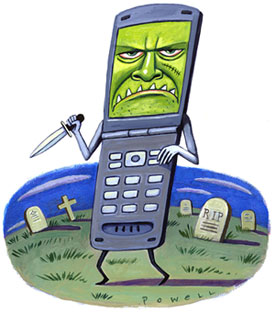
My opinion on all of this is that everyone should just get cell phones. It really isn't that bad and the option to turn it off is always available. No one says that you have to actually USE the phone, but as long as you have it you're much better off. My only other complaint is that some people use their phone too much and rely on it more than their own judgment. When it gets to that point, I'd say it's probably for the best if the phone gets tied to a stone and thrown in a lake.
First of all, I found this article absolutely fascinating. I couldn't imagine life without having my cell phone! Always being available is just a change in the times, and it's something that everyone has to adapt to, in my opinion. It's virtually impossible to live, as well as maintain social connections without one.
In fact, it's even hard to maintain social connections and plans WITH a cell phone! Just the other day I wanted to make plans with my friend Jon, but he was out driving (in preparation for his road test) and he left his phone in his room. I also tried calling his house, but no one was home. Even sometimes when Jon is home, he still leaves his phone on silent or vibrate and I have to call his landline in order to get a hold of him.
In order to understand this new expectation of cell phones, we must first understand the social change that the cell phone created. According to the works of Winston, the cell phone would be seen as an evolutionary technology because it improved upon a device that was already in place. The standard telephone was now mobile and could easily be carried by a person as they go about their day.
There was one main accelerator that speeded up the cell phone's invention. People always needed to be available. Originally, the solution was the invention of the beeper, but they were only able to tell people to call someone else. Businesses needed an easier way to get in contact with their employees and families needed ways to get in contact with their relatives for emergencies. Friends needed a way to make plans on the go. Each of these needs to always be available lead to the eventual invention of the cell phone.
There was also one very large decelerator or "brake" as Winston would call it, that slowed the development of cell phones. This was the fear that people would never be alone again. While always being available is very convenient, it can also get extremely annoying extremely fast. For instance, on the day I asked out my girlfriend, right while I was in the middle of making out with her for the first time, my phone went off. (It was my best friend Jon...how typical...) It was very annoying, I hadn't expected it, and I turned that beast right off. (The funny part is that the exact same thing happened again on a different day...same makeout spot and everything...) This fear or always being available kept many people from getting phones, but as the article states, "it’s really getting impossible not to have one."
My opinion on all of this is that everyone should just get cell phones. It really isn't that bad and the option to turn it off is always available. No one says that you have to actually USE the phone, but as long as you have it you're much better off. My only other complaint is that some people use their phone too much and rely on it more than their own judgment. When it gets to that point, I'd say it's probably for the best if the phone gets tied to a stone and thrown in a lake.
Blog Entry 4 (Mid Term)
For my fourth post, I would like to describe something interesting that I noticed about Facebook.
First off, my opinion is actually an extension of my classmate's blog post about deleting yourself on Facebook. In this post, she argued that deleting your Facebook profile is almost like deleting a part of yourself. I agree with this basic concept, but I would like to put my own spin on it.
If there is one thing that I noticed about online profiles, it is that they don't usually accurately reflect the person that created them. This is true for Facebook pages, myspace pages, youtube profiles, and even dating site profiles. The person creating the page usually will "beef up" their profile with exaggerations of the truth as well as flattering pictures and tidbits of information that give the other users of the site the wrong impression.
In fact, both of my parents, after they got divorced, created Match.com pages. On these pages, just like I mentioned above, they both put "flattering" pictures of themselves, and absolutely "beefed up" the truth. They also (conveniently), only mentioned positive and good things about themselves while leaving out the negatives. This is the perfect example of how profile pages on site can give the wrong, or an exaggerated impression of a person.
Because of this freedom to post up just about anything without it being verified as true, people have the ability to shape themselves to be whoever they want online. In this respect, when they create a Facebook account, for example, they aren't creating a page about themselves, they are creating a page representing who they WANT to be! I would like to make the argument that the profiles of different people are actually separate entities. In this way, I would also like to argue that the relationship that the creator has with their profile can be explained by Meyrewitz's theory of social space and relationships.
Meyrewitz's theory states that different mediums have the ability to remove social boundaries and permit users to believe that they are friends with people that they view on that medium. He also states that in some cases, users may believe to be the person that they see on the medium. In my Facebook example, the profile creator sees himself as the person in his profile. He doesn't necessarily realize that it is not he who appears on his page, but instead it is his own distorted image of himself. He is absolutely immune to his own weaknesses and is only able to view the positive aspects of himself or the person that he aspires to be. I'm aware that this is an incredibly odd argument, but it makes perfect sense to me! (Sorry if it's a little hard to follow)
In sum, the creator of a profile page on a website is actually creating a different person based upon who the creator wants to be. Over time, the creator believes that he ACTUALLY IS who he represents himself to be in his profile and develops a para-social relationship with his creation.
As a last note, the reason it is so hard to give up or delete a Facebook page is because it's not necessarily deleting a part of yourself, it's more like deleting who you aspire to be...and there are not many people willing to give up on their dreams.
Sunday, November 8, 2009
First off, my opinion is actually an extension of my classmate's blog post about deleting yourself on Facebook. In this post, she argued that deleting your Facebook profile is almost like deleting a part of yourself. I agree with this basic concept, but I would like to put my own spin on it.
If there is one thing that I noticed about online profiles, it is that they don't usually accurately reflect the person that created them. This is true for Facebook pages, myspace pages, youtube profiles, and even dating site profiles. The person creating the page usually will "beef up" their profile with exaggerations of the truth as well as flattering pictures and tidbits of information that give the other users of the site the wrong impression.
In fact, both of my parents, after they got divorced, created Match.com pages. On these pages, just like I mentioned above, they both put "flattering" pictures of themselves, and absolutely "beefed up" the truth. They also (conveniently), only mentioned positive and good things about themselves while leaving out the negatives. This is the perfect example of how profile pages on site can give the wrong, or an exaggerated impression of a person.
Because of this freedom to post up just about anything without it being verified as true, people have the ability to shape themselves to be whoever they want online. In this respect, when they create a Facebook account, for example, they aren't creating a page about themselves, they are creating a page representing who they WANT to be! I would like to make the argument that the profiles of different people are actually separate entities. In this way, I would also like to argue that the relationship that the creator has with their profile can be explained by Meyrewitz's theory of social space and relationships.
Meyrewitz's theory states that different mediums have the ability to remove social boundaries and permit users to believe that they are friends with people that they view on that medium. He also states that in some cases, users may believe to be the person that they see on the medium. In my Facebook example, the profile creator sees himself as the person in his profile. He doesn't necessarily realize that it is not he who appears on his page, but instead it is his own distorted image of himself. He is absolutely immune to his own weaknesses and is only able to view the positive aspects of himself or the person that he aspires to be. I'm aware that this is an incredibly odd argument, but it makes perfect sense to me! (Sorry if it's a little hard to follow)
In sum, the creator of a profile page on a website is actually creating a different person based upon who the creator wants to be. Over time, the creator believes that he ACTUALLY IS who he represents himself to be in his profile and develops a para-social relationship with his creation.
As a last note, the reason it is so hard to give up or delete a Facebook page is because it's not necessarily deleting a part of yourself, it's more like deleting who you aspire to be...and there are not many people willing to give up on their dreams.
Sunday, November 8, 2009
Saturday, November 7, 2009
Blog Entry 3 (Mid Term)
For my third post, I would like to examine my relationship with my car radio. Now, as a dorm student, I'm not in my car nearly as much as some other students are. However, I do travel home regularly and I live about 45 minutes away so I do spend a decent amount of time in my car each week.
Whenever I do travel, even if it's just for about 3 minutes up to Lorber Hall for my accounting class, I always turn on my car radio. I can't explain it, but for some reason, I just feel the impulse to listen to rock music while I drive. I tried to reason it out in my head, and I came up with several reasons why I do this.
First of all, for the most part, when I drive, I'm usually alone. Now, this may not seem like a reason at all, but I'll happily explain it. In my mind, the radio is almost like a person to me because it both communicates and entertains. Its music can be looked at as a parallel to conversation. When 2 people get in a car, they don't necessarily have a conversation prepared and the randomness of small talk is reflected in the radio station's music choice. The general topic of "conversation" is established with the genre of the radio station, but where the "conversation" goes itself is reflected in the songs that the station plays. In this respect, the radio represents a physical person to me and keeps me company in just about the same way as another person would. I feel as if this relates to a particular theory, but the closest I could possibly relate it to would be Meyrewitz's theory of social space and para-social relationships. In a way, it can be argued that I have a para-social relationship with my car radio for the reason that it communicates with me and I sing back to it...
The second reason that I constantly turn on my radio is because of status. There's nothing quite like driving up next to someone at a red light with the window open and the radio absolutely blaring "Sweet Home Alabama." I can't really explain it, but whenever I'm driving and a good song comes on I'll raise my volume a heck of a lot, open my window, and try to look pretty dang cool in my corolla. It's just a cheap thrill really, but it makes me feel unique and special and as far as I'm concerned, that's a good thing!
From this I have gathered that each person's experience with different mediums is quite dependent on what the purpose of using that medium is. For me, I use my car radio to keep myself company, get some entertainment, and look cool. Others might use the radio as a method to hear the news, traffic, or maybe to just help them relax. Whatever the reason may be, each of their experiences will be different and unique.
Thanks for listening, and if anyone ever sees a blue corolla with a driver wearing aviators and blasting classic rock music...that's probably me so wave and shout hello so I can hear you.
Saturday, November 7, 2009
Whenever I do travel, even if it's just for about 3 minutes up to Lorber Hall for my accounting class, I always turn on my car radio. I can't explain it, but for some reason, I just feel the impulse to listen to rock music while I drive. I tried to reason it out in my head, and I came up with several reasons why I do this.
First of all, for the most part, when I drive, I'm usually alone. Now, this may not seem like a reason at all, but I'll happily explain it. In my mind, the radio is almost like a person to me because it both communicates and entertains. Its music can be looked at as a parallel to conversation. When 2 people get in a car, they don't necessarily have a conversation prepared and the randomness of small talk is reflected in the radio station's music choice. The general topic of "conversation" is established with the genre of the radio station, but where the "conversation" goes itself is reflected in the songs that the station plays. In this respect, the radio represents a physical person to me and keeps me company in just about the same way as another person would. I feel as if this relates to a particular theory, but the closest I could possibly relate it to would be Meyrewitz's theory of social space and para-social relationships. In a way, it can be argued that I have a para-social relationship with my car radio for the reason that it communicates with me and I sing back to it...
The second reason that I constantly turn on my radio is because of status. There's nothing quite like driving up next to someone at a red light with the window open and the radio absolutely blaring "Sweet Home Alabama." I can't really explain it, but whenever I'm driving and a good song comes on I'll raise my volume a heck of a lot, open my window, and try to look pretty dang cool in my corolla. It's just a cheap thrill really, but it makes me feel unique and special and as far as I'm concerned, that's a good thing!
From this I have gathered that each person's experience with different mediums is quite dependent on what the purpose of using that medium is. For me, I use my car radio to keep myself company, get some entertainment, and look cool. Others might use the radio as a method to hear the news, traffic, or maybe to just help them relax. Whatever the reason may be, each of their experiences will be different and unique.
Thanks for listening, and if anyone ever sees a blue corolla with a driver wearing aviators and blasting classic rock music...that's probably me so wave and shout hello so I can hear you.
Saturday, November 7, 2009
Blog Entry 2 (Mid Term)
For my second blog post, I would like to describe my observations regarding economic gain and different types of media.
As I'm sure everybody in our class knows, I am quite an avid video gamer. As far as games go, I enjoy shooters, racing games, and strategy the best. Video games are the type of media that entertain me and keep me relaxed. Without video games I might become unstrung and who knows what will happen!? I'm just messing around, I don't rely on them that much, but I still do play a LOT!
In any case, when I play these different types of games, I notice a pattern that involves the advertisement of products. In some cases, the ad is subtle, and unless you're particularly looking for it, you'd never notice it in a million years. However, some games are just full of advertisement and despite that, it doesn't really register with the player that they're being advertised to.
For instance, I recently purchased "Forza Motorsport 3" and began playing it non-stop for the day. Now, I don't know how many other video games are in our class, but if there is one thing about racing games that is important to note, it's that these types of games are becoming more and more realistic. In this respect, they are literally full of REAL ads for REAL products in REAL places!
For example, on one track, there are billboards all around advertising products ranging from cars to gilette razors. However, as the players of the game, it is easy to overlook these ads and in the beginning, I didn't even notice them. It wasn't until we went over the economic factors that help to drive and shape the media until I really began to notice all of these advertisements. These video games that advertise products are the perfect justification of Hilmnes and Starr's theories that the media are driven by what the market demands. Video games, that were once used as interactive toys and no more are now being molded to promote and advertise products for corporate America because it can create a profit. Instead of being solely about entertainment, the medium of video gaming has been changed, which is the absolute representation of Hilmnes and Starr's economic media theories.
Advertising in video games is also quite ingenious because it allows businesses and companies to mask advertisement with the ploy of interactive entertainment. Casual and hardcore gamers such as myself play these games regularly and take in all of the advertising without even realizing it. Then, we go shopping and we choose products that sound familiar for some reason (such as the gillette razor).
This is incredibly effective because these subtle advertisements end up in our subconscious minds and are never recognized for what they truly are! So if you or anyone else ever plays a game in the future, keep an eye out, because what you're playing might actually not be a game, but instead, one long product advertisement...

This screenshot shows a typical racetrack in Forza 3. In this shot I spy a TGI Friday's, Kodak...
Friday, November 6, 2009
As I'm sure everybody in our class knows, I am quite an avid video gamer. As far as games go, I enjoy shooters, racing games, and strategy the best. Video games are the type of media that entertain me and keep me relaxed. Without video games I might become unstrung and who knows what will happen!? I'm just messing around, I don't rely on them that much, but I still do play a LOT!
In any case, when I play these different types of games, I notice a pattern that involves the advertisement of products. In some cases, the ad is subtle, and unless you're particularly looking for it, you'd never notice it in a million years. However, some games are just full of advertisement and despite that, it doesn't really register with the player that they're being advertised to.
For instance, I recently purchased "Forza Motorsport 3" and began playing it non-stop for the day. Now, I don't know how many other video games are in our class, but if there is one thing about racing games that is important to note, it's that these types of games are becoming more and more realistic. In this respect, they are literally full of REAL ads for REAL products in REAL places!
For example, on one track, there are billboards all around advertising products ranging from cars to gilette razors. However, as the players of the game, it is easy to overlook these ads and in the beginning, I didn't even notice them. It wasn't until we went over the economic factors that help to drive and shape the media until I really began to notice all of these advertisements. These video games that advertise products are the perfect justification of Hilmnes and Starr's theories that the media are driven by what the market demands. Video games, that were once used as interactive toys and no more are now being molded to promote and advertise products for corporate America because it can create a profit. Instead of being solely about entertainment, the medium of video gaming has been changed, which is the absolute representation of Hilmnes and Starr's economic media theories.
Advertising in video games is also quite ingenious because it allows businesses and companies to mask advertisement with the ploy of interactive entertainment. Casual and hardcore gamers such as myself play these games regularly and take in all of the advertising without even realizing it. Then, we go shopping and we choose products that sound familiar for some reason (such as the gillette razor).
This is incredibly effective because these subtle advertisements end up in our subconscious minds and are never recognized for what they truly are! So if you or anyone else ever plays a game in the future, keep an eye out, because what you're playing might actually not be a game, but instead, one long product advertisement...
This screenshot shows a typical racetrack in Forza 3. In this shot I spy a TGI Friday's, Kodak...
Friday, November 6, 2009
Blog Entry 1 (Mid Term)
For my first blog post, I would like to reflect a little bit on the change that Facebook created in society and how it relates to the theory of technological determinism and the medium theory.
When it was created, Facebook was intended on being a website for college students to permit them to get to know each other better and glance into each other's lives. Prior to Facebook, forum websites, blogs, and myspace pages were the main methods in which people would express themselves online and although they were popular, they lacked class in many situations (at least according to my standards). They also lacked unity, and in a way, no two myspace pages were the same and it was difficult to compare and contrast people based on their pages.
In my opinion, Facebook provided the unity and the class that permitted its own growth and popularity to prosper. Facebook uses a very particular template in it's user profile pages which allows for the simple and easy access of information on people's pages. By using a uniform system, comparisons and contrasts can also be made.
This basis brings me to my main point. It all began with an observation of myself and my best friend Jon. When I first began to have feelings for my girlfriend, I immediately checked out her facebook page to learn more about her. The same could be said for Jon. He, recently, within the last month, developed a crush for another girl and when I asked about her, one of the first things that he told me was that she didn't have a facebook (and then he made a disappointed face).

Jon and I at the C.W. Post Homecoming
The medium of Facebook has created new standards in our society. It's properties of being readily available to anyone at the click of a button has created the belief that one can easily view another person and learn a lot about them at their own convenience. In fact, it can even be argued that by simply viewing a Facebook profile, one can learn more about a person than if they talked to them for hours!
In my case and in my friend Jon's case, the technology/medium that is Facebook changed the way we acquire social information. This in itself is the perfect example of technological determinism and the medium theory. Before Facebook, we still had access to information about other people's lives, but we had to access it through verbal communication or communication over the phone or internet. In essence, Facebook eliminated the human element; it permitted the relay of information to commence with only one party. This is true because the owner of the Facebook profile page does not have to do anything in order to have people view his/her profile.
Thursday, November 5, 2009
When it was created, Facebook was intended on being a website for college students to permit them to get to know each other better and glance into each other's lives. Prior to Facebook, forum websites, blogs, and myspace pages were the main methods in which people would express themselves online and although they were popular, they lacked class in many situations (at least according to my standards). They also lacked unity, and in a way, no two myspace pages were the same and it was difficult to compare and contrast people based on their pages.
In my opinion, Facebook provided the unity and the class that permitted its own growth and popularity to prosper. Facebook uses a very particular template in it's user profile pages which allows for the simple and easy access of information on people's pages. By using a uniform system, comparisons and contrasts can also be made.
This basis brings me to my main point. It all began with an observation of myself and my best friend Jon. When I first began to have feelings for my girlfriend, I immediately checked out her facebook page to learn more about her. The same could be said for Jon. He, recently, within the last month, developed a crush for another girl and when I asked about her, one of the first things that he told me was that she didn't have a facebook (and then he made a disappointed face).
Jon and I at the C.W. Post Homecoming
The medium of Facebook has created new standards in our society. It's properties of being readily available to anyone at the click of a button has created the belief that one can easily view another person and learn a lot about them at their own convenience. In fact, it can even be argued that by simply viewing a Facebook profile, one can learn more about a person than if they talked to them for hours!
In my case and in my friend Jon's case, the technology/medium that is Facebook changed the way we acquire social information. This in itself is the perfect example of technological determinism and the medium theory. Before Facebook, we still had access to information about other people's lives, but we had to access it through verbal communication or communication over the phone or internet. In essence, Facebook eliminated the human element; it permitted the relay of information to commence with only one party. This is true because the owner of the Facebook profile page does not have to do anything in order to have people view his/her profile.
Thursday, November 5, 2009
Wednesday, November 4, 2009
Pandora Review

Is Pandora truly worth listening to? Well, I decided to find out for myself. First of all, Pandora is a website that offers free internet radio that is customizable by the user. By simply putting in a song or a band title, Pandora will search through its archives and play songs that have similar musical qualities to either the song or the band that was selected. Pandora is absolutely free to use, although a premium version is available. The free version of Pandora offers approximately 40 free hours of listening per month and from time to time, a commercial will play. The premium version of Pandora features unlimited listening as well as commercial free listening.
I set up an account for myself to see if Pandora was really as good as it was hyped up to be. I initially created two stations, a contemporary rock station with music from artists such as Rise Against and Sum 41 and a classic rock station featuring music by artists such as Tom Petty, Journey, Kansas, and Lynyrd Skynyrd. At first listen, Pandora didn't seem that impressive. It didn't play the initial song that I requested and the first few songs weren't really that great. However, as I began to give songs the thumbs up or the thumbs down, Pandora started to "learn" from my music choices. Songs that I recognized began to play and even though I had never known the band or the name of the song, I was easily able to sing along and take note of who the music was by.
Overall, I was very impressed with the power of Pandora. Long term, I think it might end up having a substantial effect on other types of mediums such as the ipod, as well as standard fm radio. As far as the ipod goes, I believe that Pandora can have either one of two effects. The first possibility is that Pandora listeners find music that they like on Pandora and then purchase it on itunes and play it on their ipods whenever they like. In this scenario, Pandora internet radio would have a positive effect on the sales and use of the ipod. In the second scenario, the ipod users would replace listening to their ipod with listening to Pandora. In this case, the ipod would lose users and the effect would be negative.
As far as FM radio goes, I predict that FM is going to lose a lot of ground due to Pandora. FM radio generally plays one type of genre per station and there is no changing this. Pandora, unlike standard FM radio, adapts to the user's tastes and music preferences and permits the user to skip songs, ban artists, and ban different songs from being played. In this respect, I believe that Pandora will slowly outgrow FM radio because of the fact that it is a lot more customizable than regular radio. Perhaps one of the most contributing factors that will help Pandora outgrow FM is the fact that Pandora is available on the iphone which can be carried everywhere rather than only in the car or in a stereo system such as a standard radio.
The process of song selection of Pandora is a truly revolutionary process because it doesn't play the song that users specifically request and it doesn't even play the selected band in most cases. However, it still manages to be hugely successful because it plays the sound that people like and helps people discover different songs and artists that they never would have otherwise been introduced to. In my own experience with Pandora, this process has been excessively beneficial and not only am I identifying songs that I never knew the titles to, I am also discovering new bands and songs that I've never heard. This method is absolutely fantastic and although it breaks the rules, as mentioned in the "Times" article, it is still hugely successful.
Subscribe to:
Posts (Atom)
